


Table of Contents
- What Is NCLT and Why Does It Matter?
- Reason 1 — Insolvency and Bankruptcy Proceedings (IBC Cases)
- Reason 2 — Oppression and Mismanagement by Directors
- Reason 3 — Shareholder and Minority Rights Disputes
- Reason 4 — Company Mergers, Demergers, and Amalgamations
- Reason 5 — Wrongful Removal or Disqualification of Directors
- Reason 6 — Recovery of Dues by Operational and Financial Creditors
- Reason 7 — Winding Up of a Company
- How to Choose the Right NCLT Lawyer in India
- Frequently Asked Questions (FAQs)
- Conclusion
What Is NCLT and Why Does It Matter?
The National Company Law Tribunal (NCLT) is a quasi-judicial body established under the Companies Act, 2013. It serves as the principal forum for resolving corporate disputes in India and handles matters ranging from insolvency and liquidation to shareholder conflicts and company restructuring.
Before the NCLT was established in 2016, corporate matters were scattered across multiple forums — the Company Law Board, the Board for Industrial and Financial Reconstruction (BIFR), and various High Courts. NCLT consolidated all these functions under one roof, making it the single most important legal forum for businesses in India.
Since then, NCLT has disposed of over 7,000+ insolvency cases and resolved disputes involving some of India's largest corporations. For any business — whether a startup in Indore or a listed company in Mumbai — understanding why and when to approach NCLT can be a decisive competitive and legal advantage.
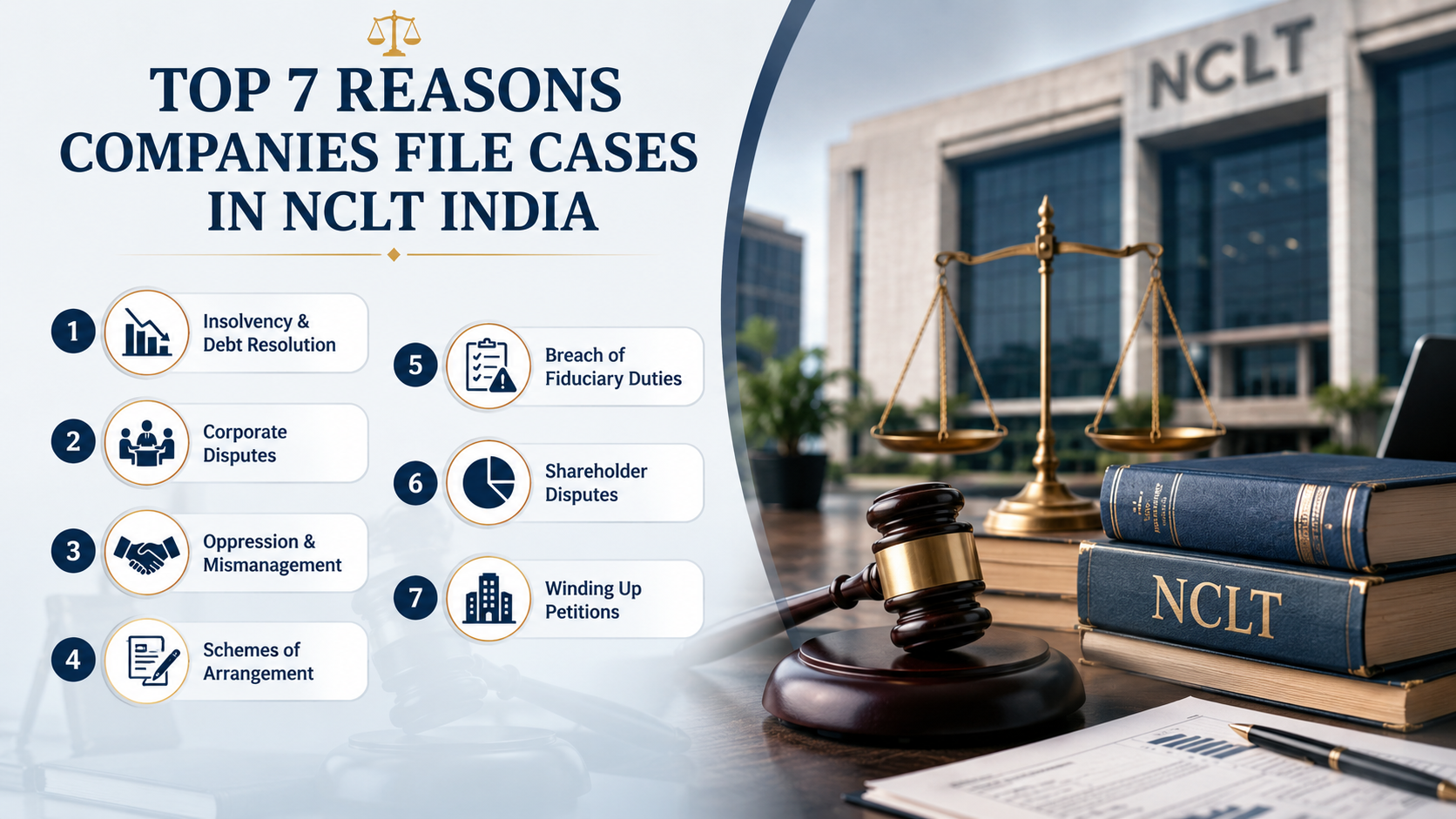
At Accorg Consulting, our NCLT lawyers in Indore have represented clients across all categories of NCLT matters. In this blog, we break down the top 7 reasons companies file cases in NCLT, with real-world context and expert guidance.
Reason 1 — Insolvency and Bankruptcy Proceedings (IBC Cases)
The single largest category of NCLT filings in India involves corporate insolvency resolution under the Insolvency and Bankruptcy Code (IBC), 2016.
When a company defaults on a debt of ₹1 crore or more (revised threshold post-COVID), creditors — both financial and operational — can file an insolvency petition before NCLT. Once admitted, a Corporate Insolvency Resolution Process (CIRP) is initiated, and a Resolution Professional takes over the management of the company.
Who can file:
- Financial creditors (banks, NBFCs, debenture holders)
- Operational creditors (vendors, service providers, employees)
- The corporate debtor itself (voluntary insolvency)
Key timelines: CIRP must be completed within 180 days, extendable to 330 days.
IBC cases are the most time-sensitive NCLT matters. Delays in filing or errors in documentation can result in losing your rights entirely. If you are a creditor or a defaulting company, consulting an experienced insolvency lawyer in India at the earliest is critical.
Reason 2 — Oppression and Mismanagement by Directors
One of the oldest and most litigated NCLT matters involves petitions filed under Section 241–242 of the Companies Act, 2013, dealing with oppression and mismanagement within a company.
These cases typically arise when:
- Majority shareholders or directors make decisions that are prejudicial to the interests of minority shareholders
- Company funds are siphoned off or misused by promoters or directors
- Board meetings are called without proper notice, or resolutions are passed illegally
- The affairs of the company are being conducted in a manner that is oppressive to any member
NCLT has wide powers in such matters. It can remove directors, order the purchase of shares, set aside fraudulent transactions, and even wind up the company if no other remedy is adequate.
These petitions require strong documentary evidence and a deep understanding of corporate governance law. An experienced NCLT lawyer in India can help you assess whether your situation qualifies and strategise the filing effectively.
Reason 3 — Shareholder and Minority Rights Disputes
Closely related to oppression cases, shareholder disputes form a significant portion of NCLT filings — especially in family-owned businesses, joint ventures, and closely held companies.
Common triggers include:
- Refusal to pay dividends despite available profits
- Dilution of shareholding without consent
- Exclusion of a co-founder from business operations
- Disputes over share transfers, buyback, or valuation
- Deadlock between equal shareholders in a 50:50 company
Under the Companies Act, 2013, even a minority shareholder holding 10% or more equity can approach NCLT to protect their rights. NCLT can grant interim reliefs, including injunctions against share transfers or board decisions, while the case is being heard.
If you are a shareholder dispute lawyer handling such matters or a business owner caught in one, timely intervention at NCLT can prevent irreversible damage.
Reason 4 — Company Mergers, Demergers, and Amalgamations
NCLT is the only forum authorised to approve schemes of merger, demerger, and amalgamation between companies in India under Sections 230–232 of the Companies Act, 2013.
Whether two companies are merging for strategic synergy, a conglomerate is demerging a division into a separate entity, or a holding company is absorbing a subsidiary — all such corporate restructuring requires NCLT approval.
The process involves:
- Board approval and filing of the scheme
- NCLT directing convening of shareholder and creditor meetings
- Voting by shareholders and creditors
- NCLT hearings and final order of sanction
The entire process typically takes 6 to 18 months, depending on complexity and objections raised. Corporate law firms in Indore like Accorg Consulting handle end-to-end merger filings, including drafting the scheme, managing NCLT appearances, and coordinating with ROC and tax authorities.
Reason 5 — Wrongful Removal or Disqualification of Directors
Directors who are wrongfully removed from the board or improperly disqualified under Section 164 of the Companies Act, 2013, frequently approach NCLT for relief.
This is especially common in:
- Family disputes where one branch of the family votes out another from the board
- Disputes in joint ventures where one party tries to remove the other's nominee director
- Cases where a director is disqualified due to non-filing of returns for the company without their knowledge
NCLT can reinstate a director, declare a removal as illegal, or provide appropriate compensation.
In director dispute cases, speed matters enormously. Once a wrongful removal is recorded in the Ministry of Corporate Affairs (MCA) portal, reversing it without an NCLT order becomes very difficult. Early legal consultation with a director dispute lawyer in India can preserve your position before it deteriorates.
Reason 6 — Recovery of Dues by Operational and Financial Creditors
NCLT has emerged as one of the most powerful recovery forums in India, particularly for operational creditors — suppliers, vendors, contractors, and service providers — who have struggled for years to recover dues from defaulting companies.
Under the IBC framework, an operational creditor can issue a demand notice (Form 3 under IBC) to the corporate debtor. If the dues are not paid or disputed within 10 days, the creditor can file an insolvency petition before NCLT.
The mere threat of NCLT admission and loss of management control has proven to be a highly effective lever to force settlements and recover legitimate dues.
Key advantage: Unlike civil courts, NCLT proceedings are time-bound and backed by statutory timelines, making them far more efficient for creditors than a regular money recovery suit.
Businesses facing non-payment — particularly in sectors like construction, manufacturing, and logistics — are increasingly choosing the NCLT route over traditional civil litigation.
Reason 7 — Winding Up of a Company
Finally, NCLT is the designated tribunal for voluntary and compulsory winding up of companies under the Companies Act, 2013.
Compulsory winding up by NCLT can be ordered when:
- The company is unable to pay its debts
- The company has acted against the interests of national security or sovereignty
- There has been fraud in the formation or promotion of the company
- The tribunal finds it just and equitable to wind up the company
Voluntary winding up under the Insolvency and Bankruptcy Code is a separate but parallel process initiated by shareholders when the company is solvent but the promoters wish to close operations.
Winding up proceedings require careful navigation — from securing creditor consents and settling employee dues to distributing remaining assets. An NCLT lawyer with experience in liquidation and winding up matters ensures that the process is completed without regulatory complications.
How to Choose the Right NCLT Lawyer in India
Filing a case before NCLT is not merely a documentation exercise — it requires deep understanding of corporate law, IBC, SEBI regulations, and RBI guidelines, depending on the nature of the dispute.
Here is what to look for when choosing an NCLT lawyer:
1. Specialisation in Corporate Law
Ensure the law firm handles NCLT matters regularly, not occasionally. NCLT practice is distinct from general civil or criminal litigation.
2. Experience in Your Specific Type of Case
Insolvency cases differ significantly from oppression petitions or merger approvals. Look for a lawyer who has handled your specific category of case.
3. Location and Bench Familiarity
NCLT has 16 benches across India. Lawyers familiar with the local bench — its procedures, judges, and practice norms — are significantly more effective.
4. Transparent Communication and Timelines
NCLT matters have strict statutory deadlines. Your lawyer must keep you informed and act proactively.
At Accorg Consulting, our team of dedicated NCLT and insolvency lawyers in Indore serves clients across Madhya Pradesh and pan-India, offering expert representation at NCLT benches with a focus on results-driven legal strategy.
📞 Contact Accorg Consulting today for a confidential consultation on your NCLT matter.
Frequently Asked Questions (FAQs)
Q1. What is the minimum threshold to file an insolvency case in NCLT?
The minimum default amount to file a corporate insolvency petition under the IBC before NCLT is ₹1 crore. This threshold was increased from ₹1 lakh to ₹1 crore in 2020 to prevent frivolous filings.
Q2. How long does an NCLT case take in India?
It depends on the type of case. CIRP (insolvency) matters are time-bound at 180–330 days. Oppression and mismanagement petitions can take 1–3 years depending on complexity and interim applications. Merger approvals typically take 6–18 months.
Q3. Can an individual director be personally held liable in NCLT proceedings?
Yes. NCLT can hold directors personally liable in cases involving fraudulent trading, wrongful trading, or misappropriation of company assets under relevant sections of the Companies Act and IBC.
Q4. Is it mandatory to hire a lawyer for NCLT proceedings?
While parties can technically appear in person, NCLT proceedings involve complex legal and procedural requirements. Having a qualified NCLT lawyer is strongly recommended to protect your interests and avoid procedural errors that could weaken your case.
Q5. Can NCLT cases be settled out of court?
Yes. NCLT encourages settlements and allows parties to resolve disputes through mediation or mutual agreement at any stage of the proceedings. A settlement at the NCLT stage can be significantly faster and less expensive than a full trial.
Q6. Which NCLT bench has jurisdiction over companies in Madhya Pradesh?
Companies registered in Madhya Pradesh fall under the jurisdiction of the NCLT Mumbai Bench (Principal Bench allocation may vary; please verify the latest bench allocation as per MCA notifications). For matters specific to Indore or MP, consult a corporate law firm in Indore with active NCLT practice.
Q7. What documents are needed to file an insolvency petition in NCLT?
Key documents include: proof of debt (loan agreements, invoices, sanction letters), proof of default (bank statements, demand notices), company incorporation documents, and the demand notice served under IBC. A lawyer will compile a complete checklist based on your specific case.
Conclusion
The National Company Law Tribunal is not just a court of last resort — it is a proactive legal tool that companies, creditors, directors, and shareholders can use to protect their rights and enforce accountability in India's corporate ecosystem.
Whether you are a lender seeking to recover dues, a minority shareholder fighting oppression, a company planning a merger, or a director facing wrongful removal — NCLT is the forum that can deliver decisive legal outcomes.
Understanding the right time and reason to approach NCLT — and doing so with the right legal representation — can mean the difference between a resolved dispute and a prolonged, expensive battle.
Accorg Consulting brings together a team of experienced NCLT lawyers, insolvency professionals, and corporate law experts in Indore who are equipped to guide you through every stage of NCLT proceedings with clarity, strategy, and commitment.
📌 Disclaimer: This blog is intended for general informational purposes only and does not constitute legal advice. For advice specific to your situation, please consult a qualified NCLT lawyer.
